I Knew the Answers, Still Failed the Interview – Here’s What Was Missing
I remember the date. It was a Tuesday. I was wearing a shirt that I had ironed twice. I was sitting in the lobby of a company I had dreamed of working for since college.
I was ready. Or at least, I thought I was.
I had spent three weeks “prepping.” I had read every article on their tech stack. I had memorized the company values. I had reviewed my own resume until I could recite it backward. On paper, I was the perfect candidate. I had the degree, the certification, and the exact experience they asked for in the job description.
But twenty minutes later, I was walking back to the elevator, my face burning with embarrassment. I didn’t need to wait for the rejection email to know the truth: I had failed the interview.
The worst part? I actually knew the answers to their questions.
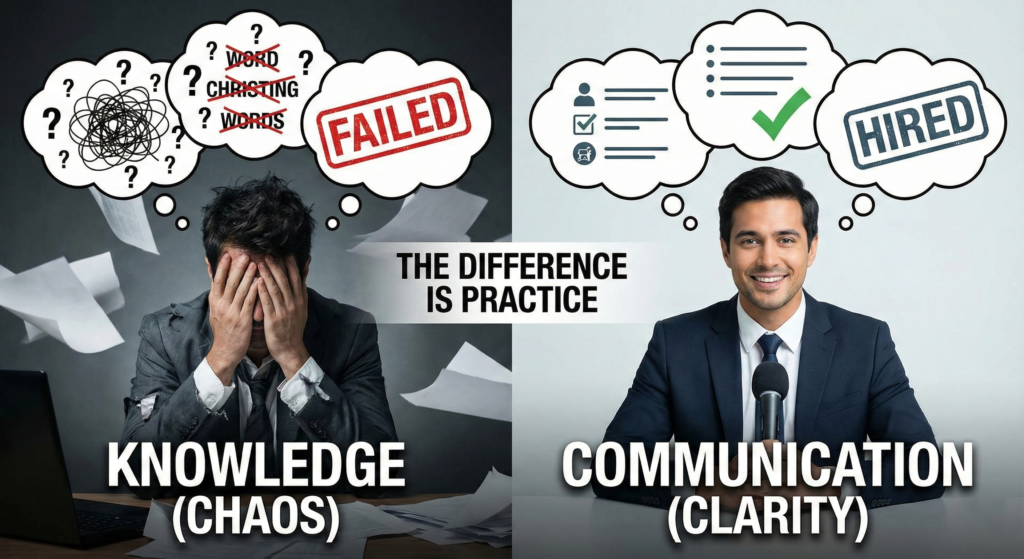
If they had sent me a written exam, I would have scored 100%. But they didn’t ask for a written exam. They asked for a conversation. And that is where I fell apart.
If this sounds familiar to you, I want you to know you aren’t alone. And more importantly, I want to tell you that it isn’t a lack of talent. It’s a lack of a specific kind of practice.
The “Exam Mindset” Trap
The reason I failed (and why so many qualified people fail) is that I treated the interview like a university exam.
In school, if you memorize the textbook, you pass. We are trained to believe that Information = Success.
But an interview is not an information exchange. It is a trust exchange.
The interviewer didn’t just want to know if I knew the SQL query or the marketing strategy. They wanted to know if I could explain it clearly under pressure. They wanted to know if I was pleasant to work with when I was stressed.
I had the data in my head, but I had zero delivery skills. I was like a chef who has the best ingredients in the world but has never actually turned on a stove.
Why We Fail When We Know the Answers
Looking back, I can pinpoint exactly where things went wrong. It wasn’t one big explosion; it was a series of small, silent failures.
1. The Nervousness Block
When the interviewer asked, “Tell me about a time you faced a conflict at work,” my brain froze.
I knew the story I wanted to tell. It was about a project deadline in my last job. But because I was nervous, my cortisol levels spiked. The logical part of my brain (the prefrontal cortex) essentially went offline.
Instead of a clear story, I rambled. I started in the middle, forgot the point, and ended with an awkward, “So… yeah.”
2. The “Ums” and “Ahs”
Because I hadn’t practiced speaking out loud, my brain was trying to buffer like a slow video connection. Every time I had to think, I said, “Ummm,” or “You know, like…”
To me, it felt like I was just thinking. To the interviewer, it sounded like I didn’t know what I was talking about. Confidence is silent; insecurity is noisy.
3. The Lack of Structure
My answers were all over the place. I gave the solution before explaining the problem. I missed the results entirely.
I realized later that knowing the answer is only 50% of the work. The other 50% is packaging that answer so the interviewer can understand it.
The Missing Link: Feedback
After that rejection, I did what we all do. I waited for feedback.
And I got the standard template: “While we were impressed with your background, we have decided to move forward with other candidates.”
This is the hardest part of the job hunt. Real interviews are a black box. You go in, you fail, and nobody tells you why. Did I talk too much? Did I seem arrogant? Did I have spinach in my teeth?
You can’t fix what you don’t know is broken.
How I Turned It Around (And How You Can Too)
I stopped reading textbooks. I stopped memorizing facts.
I started treating interviews like a sport. You don’t get better at cricket by reading about batting; you get better by standing in the nets and hitting the ball.
I started mock interview practice.
The first time I recorded myself answering a question, I was horrified. I sounded robotic. I looked away from the camera constantly. I realized my posture was terrible.
But here is the magic: once I saw it, I could fix it.
Why Practice Beats Study
-
Muscle Memory: When you practice out loud, your mouth gets used to forming the words. The “ums” disappear because you know where the sentence is going.
-
Calming the Nerves: The twentieth time you answer “Tell me about yourself,” it doesn’t feel scary anymore. It feels boring. And when you are bored, you are calm.
-
Structure: You learn to stop rambling. You learn to hit the main points and stop talking.
Finding a Safe Space to Fail
This brings me to Sparrolet.
I wish I had this app back when I was sweating in that lobby. The problem with practicing with friends is that it feels awkward. They might judge you, or they might just be too nice to tell you the truth.
Sparrolet is the safe space I needed.
It’s an app where you can mess up. You can stutter. You can freeze. You can give a terrible answer. And it’s okay, because it’s just practice.
Sparrolet acts as that mirror you need. It gives you the questions, simulates the pressure, but removes the risk. It helps you bridge the gap between knowing the answer and delivering the answer.
Key Takeaways
If you are skimming this article, here is what you need to know:
-
Knowledge ≠ Interview Skills: You can be an expert and still fail if you can’t communicate.
-
Anxiety Kills IQ: Nervousness makes you ramble. Practice reduces nervousness.
-
Feedback is Rare: Real companies won’t tell you why you failed. You need a practice tool to spot your mistakes.
-
Action: Stop reading notes. Start speaking out loud.
Frequently Asked Questions (FAQ)
1. I get very nervous before interviews. Will practice actually help?
Yes. Anxiety usually comes from the “unknown.” By doing mock interviews, you make the situation familiar. Your brain stops treating the interview as a threat and starts treating it as a routine task.
2. How many mock interviews should I do before the real one?
There is no magic number, but try to practice until you can answer the common questions (Intro, Strengths, Weaknesses) without saying “um” or looking at your notes. Even 15 minutes a day on an app like Sparrolet can make a huge difference.
3. What if I don’t know the answer to a technical question?
This happens! Practice helps here too. Instead of panicking, you can practice saying: “That’s an interesting question. I don’t know the exact answer right now, but here is how I would figure it out…” Confidence in not knowing is better than a nervous guess.
4. Is it okay to use prepared answers?
You should have “structured stories,” not memorized scripts. If you sound like you are reading a script, you will seem robotic. Practice helps you sound natural, like you are telling a story to a friend.
Final Thoughts
Failing an interview doesn’t mean you are a failure. It just means you haven’t mastered the performance yet.
I eventually got the job. Not that first one, but a better one. And I didn’t get it because I learned more technical facts. I got it because I walked into the room, looked the interviewer in the eye, and spoke with the calm confidence of someone who had practiced.
Don’t let your hard work go to waste because of a lack of practice. Open Sparrolet directly in your browser, make your mistakes today, and win the job tomorrow.
👉 Click here to Log In and Start Practicing
You’ve got this.