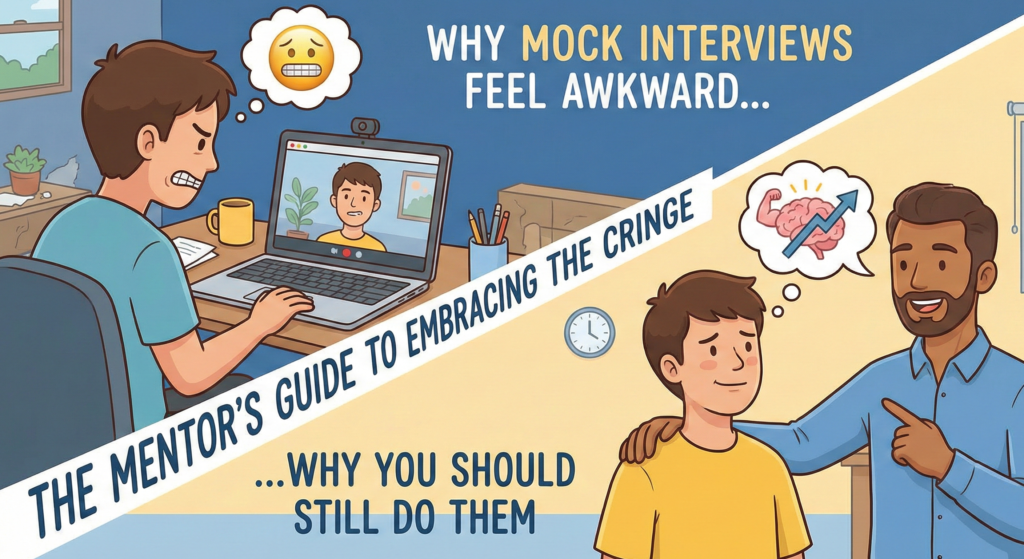
Why Mock Interviews Feel Awkward (And Why You Should Still Do Them)
Let’s be honest for a moment.
You open an interview practice online tool. You see your own face on the screen. You press “Record.” And then… you feel silly.
You are sitting alone in your room, talking to a robot or a blank screen. You feel like an actor who has forgotten their lines. You stumble over words. You hear your own voice and cringe. You might even close the laptop and walk away because it feels so unnatural.
If this is you, I want to tell you something important: You are completely normal.
Almost everyone hates doing mock interviews at first. It triggers a very specific kind of discomfort. But as a mentor, I also have to tell you a hard truth: That awkwardness is the price of admission for success.
Here is why it feels so weird, and why you need to do it anyway.
The Psychology of the “Cringe”
Why is it so hard to talk to a camera?
Human beings are wired for connection. When we speak, we are used to seeing a reaction—a nod, a smile, or a raised eyebrow. When you practice alone, that feedback loop is broken. You are sending energy out, but nothing is coming back.
This silence makes you hyper-aware of yourself.
1. The “Spotlight Effect”
When there is no one else in the room, your brain turns the spotlight entirely on you. You suddenly notice things you never worry about in normal conversation:
-
“Is my voice really that high?”
-
“Do I blink too much?”
-
“Why am I moving my hands like that?”
This isn’t vanity; it’s vulnerability. Mock interview practice forces you to confront your own image, and most of us are our own harshest critics.
2. The Fear of Being “Found Out”
When you practice answering a question like “What is your biggest weakness?” out loud, you can’t hide behind vague thoughts in your head. You have to articulate it. If the answer isn’t good, you hear it immediately. That moment of realizing “I don’t actually know what to say” is painful. It feels like failure.
But here is the secret: It is better to feel that failure now, alone in your room, than in the actual interview chair.
The Science Behind Practice: Why Discomfort Works
You might be thinking, “If it feels so unnatural, how does it help me?”
It helps because interviewing is a performance sport.
Neural Pathways and “The Groove”
When you think about an answer, you use one part of your brain. When you speak an answer, you use a completely different part (Broca’s area).
If you only practice in your head, you are training the wrong muscles. It’s like reading a book about swimming and then jumping into the deep end. You might know the theory, but your body doesn’t know the movement.
When you push through the awkwardness and speak out loud, you are building myelin. Myelin is a substance that wraps around your neural pathways. The more you repeat an action, the thicker the myelin gets, and the faster the signal travels.
In simple terms: The more you endure the awkwardness of practice, the more automatic the answers become.
Sparrolet: Your Safe Space to Be Awkward
This is why we designed Sparrolet.
We didn’t build it to be a scary test. We built it to be a private gym.
When you go to the gym, you sweat. You make funny faces when you lift heavy weights. You don’t look your best. And that is okay. That is where the muscle is built.
Sparrolet is your interview preparation app where you are allowed to be messy.
-
Stumble over your words? Good. Do it again.
-
Freeze and forget your answer? Great. Check your notes and retry.
-
Feel silly talking to AI? Perfect. That means you are trying.
The app doesn’t judge you. It doesn’t roll its eyes. It just gives you the space to get the “bad versions” of your answers out of your system so that the “good version” is ready for the real recruiter.
Reframing the Feeling
The next time you sit down to practice and feel that wave of awkwardness, try this mental shift:
Don’t think: “I look stupid doing this.” Think: “I am intentionally stressing myself now so I can be calm later.”
Every time you force yourself to finish an answer despite feeling weird, you are building psychological resilience. You are teaching your brain that you can perform even when you feel uncomfortable.
And guess what? That is exactly what a real interview is—performing while uncomfortable.
Practical Steps to Break the Ice
If you are stuck, try these baby steps to reduce the cringe:
-
Don’t Watch the Video Yet: For the first few tries on Sparrolet, cover your face on the screen with a sticky note. Just focus on your voice.
-
Start with “Low Stakes” Questions: Don’t start with the hard technical questions. Start with “Tell me about yourself.” It’s easier to speak about what you know.
-
Accept the First Draft: Your first attempt will be bad. Accept it. Laugh at it. Then press delete and do it again.
Frequently Asked Questions (FAQ)
1. Is it normal to hate the sound of my own voice?
Yes, absolutely. It’s called “voice confrontation.” You hear your voice through your skull bones (which adds bass), but recordings play it through air (which sounds higher). Everyone hates it. You get used to it after a few sessions.
2. Can’t I just practice in front of a mirror?
Mirrors are okay, but they distract you. You end up looking at your hair instead of thinking about your answer. An interview practice online tool like Sparrolet is better because it simulates the pressure of being recorded, which mimics the pressure of being watched by a recruiter.
3. How long does it take for the awkwardness to go away?
Usually, it takes about 5 to 10 practice questions. Once you get into the flow, your brain switches from “self-conscious mode” to “problem-solving mode.”
4. What if I freeze completely during a mock interview?
That is a win! You discovered a gap in your knowledge. Take a deep breath, look up the answer, and try again. Better to freeze with an app than with a hiring manager.
A Final Encouraging Thought
Growth never happens in the comfort zone.
If you are feeling awkward, it means you are stretching. It means you are doing the hard work that 90% of other candidates aren’t willing to do.
Embrace the cringe. Laugh at the awkward pauses. Trust the process.
Download Sparrolet, find a quiet corner, and let yourself be imperfect today. Because a messy practice session today is the foundation for a flawless interview tomorrow.