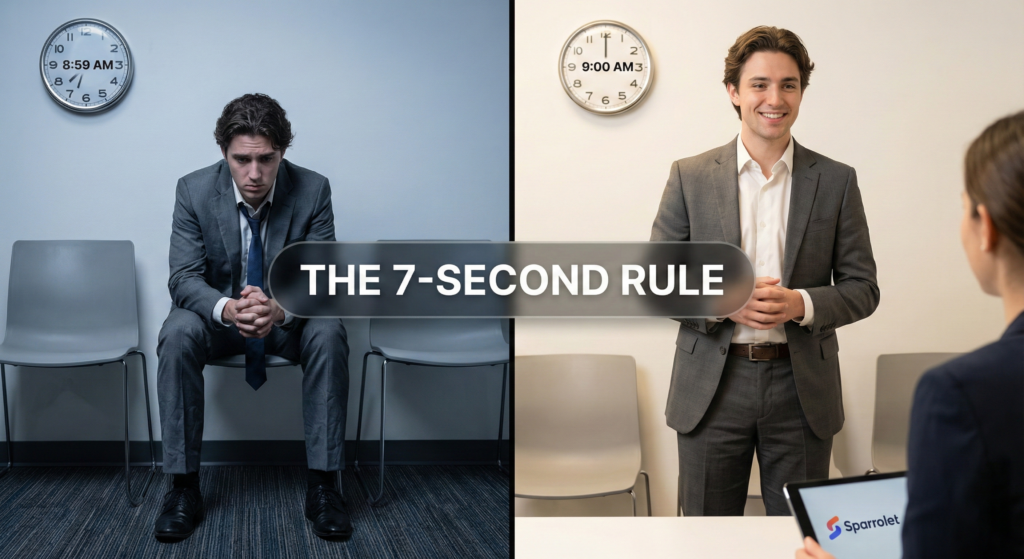
Why Most Interviews Fail Before the First Question Is Answered
We have all been there.
You are sitting in the lobby. You have checked your tie or your hair five times in the last minute. Your palms are slightly sweaty, and your heart is beating a little too fast. You have memorized your answers. You know your CV inside out. You are technically perfect for this job.
But the moment your name is called, something shifts. You walk in, sit down, and before you even open your mouth to say, “Hello,” the energy in the room feels… off.
Here is the hard truth that most career coaches won’t tell you: Most interviews are lost before the first technical question is even asked.
It isn’t because you aren’t smart. It isn’t because your degree isn’t from a top-tier university. It is because human beings are wired to judge quickly, and anxiety can hijack your best self in seconds.
Let’s break down why this happens and, more importantly, how you can fix it.
The Science of the First 7 Seconds
Psychologists have a term for this: “thin-slicing.” It refers to the ability of our brains to find patterns in events based only on “thin slices,” or very narrow windows, of experience.
Research suggests that within the first seven seconds of meeting you, an interviewer has already made a subconscious decision about your:
-
Confidence
-
Competence
-
Likeability
If you walk in looking defeated, terrified, or apologetic, you are fighting an uphill battle for the rest of the hour. You might give perfect answers later, but the interviewer’s brain is already looking for evidence to confirm their first impression that you lack confidence.
The “Imposter Syndrome” Leak
Have you ever walked into an interview thinking, “I hope they don’t find out I’m not good enough”?
That is Imposter Syndrome. The problem is, thoughts like that don’t stay in your head. They “leak” out. When you feel like a fraud, you hesitate. You qualify your answers with weak words like “maybe” or “I think.” You make yourself physically smaller in the chair.
Your mindset is the invisible uniform you wear to the interview. If that uniform says “I am scared,” the interviewer will see it.
The Silent Language of Failure
We spend 90% of our prep time thinking about what to say, and only 10% on how we look when we say it. This is a fatal mistake.
1. The Entry
How do you walk through the door? Do you shuffle in, looking at your feet? Or do you walk in with your head up, making eye contact? The walk from the door to the chair is your “opening scene.” Make it count.
2. The Handshake (or Namaste)
In a physical interview, a limp handshake feels like a lack of energy. In a video interview, looking at your own screen instead of the camera lens feels like you are avoiding connection. These small physical cues signal whether you are a leader or a follower.
3. The “Defense” Posture
When we are nervous, we protect our vital organs. We cross our arms. We hunch our shoulders. We cross our legs tightly. To an interviewer, this looks like you are closed off or defensive. Open body language—shoulders back, arms relaxed—signals that you are open to conversation and collaboration.
Why “Winging It” Doesn’t Work
Many candidates think, “I know my job, so I can just answer the questions naturally.”
But an interview is not a normal conversation. It is a high-pressure performance. When adrenaline hits your system (the “fight or flight” response), your IQ actually drops temporarily. You forget words. You ramble. You lose your train of thought.
This is where interview anxiety kills potential. You might be the best coder, the best designer, or the best accountant, but if your brain freezes, no one will ever know.
Changing the Game: Interviewing is a Skill, Not Luck
The biggest myth in job hunting is that getting hired is about luck.
“Maybe the interviewer was in a bad mood.” “Maybe they just didn’t like my face.”
While luck plays a tiny role, interviewing is a skill. Just like riding a bike or writing code. And how do you get better at a skill? You don’t just read about it. You practice it.
The Power of Mock Interview Practice
You wouldn’t walk onto a cricket field for a major match without ever holding a bat during practice, right? Yet, we walk into life-changing interviews having only practiced in our heads.
This is where mock interview practice becomes your secret weapon.
When you practice out loud, two things happen:
-
Desensitization: The more you do it, the less scary it becomes. Your brain stops seeing the interview as a “threat.”
-
Muscle Memory: You learn how to structure your answers automatically, leaving your brain free to focus on connecting with the interviewer.
Enter Sparrolet
This is exactly why we built Sparrolet. We realized that reading blog posts (like this one!) is helpful, but it doesn’t simulate the pressure.
Sparrolet isn’t just a list of questions. It is a safe space to fail. It’s an AI-powered mock interview partner that listens to you, watches your pacing, and gives you feedback before the real deal.
Imagine knowing exactly how you sound when you answer “Tell me about yourself” because you’ve already done it 20 times on the app. That isn’t just preparation; that is interview confidence.
Real-Life Scenario: The Transformation
Let’s look at two versions of the same candidate, Rahul.
Scenario A (No Practice): Rahul is nervous. He enters the room, avoids eye contact, and sits on the edge of the chair. When asked, “Why should we hire you?”, he stammers and gives a generic answer he memorized. The interviewer feels awkward and cuts the interview short.
Scenario B (With Sparrolet Practice): Rahul is still nervous, but he has practiced this. He knows his opening lines. He remembers to sit back and breathe. When the question comes, he smiles because he has answered this before. He speaks calmly. The interviewer feels his confidence and thinks, “This guy can handle pressure.”
Same Rahul. Same skills. Totally different outcome.
Frequently Asked Questions (FAQ)
1. Can you really fail an interview in the first few minutes?
Yes. Studies show that first impressions are formed in seconds. While you can recover from a bad start, it is much harder to change an interviewer’s mind once they have labeled you as “nervous” or “unprepared.”
2. How can I stop my hands from shaking during an interview?
This is caused by adrenaline. The best quick fix is deep breathing (box breathing) before you enter. Long term, the solution is mock interview practice. The more familiar the situation feels, the less adrenaline your body produces.
3. Is body language really that important for video interviews?
Absolutely. In a video call, your face and upper body are the only things the interviewer sees. Lighting, eye contact (looking at the camera), and nodding to show you are listening are critical for building a connection through a screen.
4. What is the best way to practice for an interview?
Don’t just memorize answers. Record yourself speaking. Use a tool like Sparrolet to simulate a real interaction. Listen to your recording to catch filler words like “um” and “uh.”
A Final Word: Progress Over Perfection
If you have failed interviews in the past, forgive yourself. It wasn’t because you weren’t good enough. It was likely just because you weren’t practiced enough in the skill of interviewing.
The goal isn’t to be a robot who never makes a mistake. The goal is to be a human who is comfortable in their own skin.
Take a deep breath. Download Sparrolet. Practice that introduction one more time.
You have got the skills. Now, go show them the confidence to match.