How Regular Interview Practice Can Change Your Career in 30 Days
Imagine you have to run a marathon next month. Would you wait until the night before the race to buy your shoes and go for a jog?
Of course not. You would train. You would run a little bit every day. You would build your stamina, strengthen your muscles, and fix your form over time.
Yet, when it comes to our careers, most of us do exactly the opposite. We wait until we get that terrified email—“Can you meet for an interview on Thursday?”—and then we panic. We cram. We memorize scripts. We lose sleep.
And then we wonder why we feel “rusty” in the room.
Here is the truth: Interviewing is a muscle. If you don’t use it, it atrophies. But if you train it regularly, even for just 10 minutes a day, the results can be life-changing.
In this guide, we are going to look at how a 30-day commitment to using an interview preparation app like Sparrolet can take you from anxious to unstoppable.
The Compound Effect of Daily Practice
Why 30 days?
Psychologists and habit experts agree that it takes consistent repetition to rewire the brain. When you practice interviewing daily, you aren’t just memorizing answers; you are changing your default reaction to pressure.
Most candidates suffer from “Imposter Syndrome”—the feeling that they are faking it. Daily practice kills Imposter Syndrome because it provides your brain with evidence of competence.
By the end of 30 days, you won’t just think you are ready. You will know you are ready because you have put in the reps.
The 30-Day Roadmap: From Rusty to Ready
We have broken this down into four distinct weeks. Each week focuses on a different aspect of your performance. You don’t need hours; you just need 15 minutes a day with your mock interview app.
Week 1: The “Un-Freezing” Phase
Goal: Overcome the awkwardness of hearing your own voice.
The first week is the hardest. It’s not about being perfect; it’s about getting comfortable with the sound of your own voice and the sight of your face on a screen.
-
Day 1-3: Focus solely on the “Tell me about yourself” question. Record it. Listen to it. Delete it. Do it again.
-
Day 4-5: Work on your “elevator pitch.” Can you explain what you do in under 60 seconds?
-
Day 6-7: Review your recordings. Count how many times you say “um,” “uh,” or “like.”
The Result: By the end of Week 1, the camera won’t feel like an enemy anymore. You will stop freezing when the recording starts.
Week 2: Structure and Storytelling
Goal: Master the STAR Method (Situation, Task, Action, Result).
Now that you are comfortable speaking, it’s time to clean up your content. Rambling is the number one killer of interviews.
-
Day 8-10: Identify 3 major career wins. Practice telling these stories using the STAR structure.
-
Day 11-13: Focus on “action verbs.” Instead of saying “I was responsible for,” practice saying “I spearheaded,” “I designed,” or “I resolved.”
-
Day 14: The “So What?” test. Listen to your answers and ask yourself: “Does this explain how I added value to the company?”
The Result: Your answers will go from vague, rambling thoughts to sharp, impactful stories.
Week 3: The “Curveball” Week
Goal: Build resilience against difficult questions.
This is where an interview preparation app shines. You need to be asked questions you aren’t expecting.
-
Day 15-17: Practice the “Weakness” question. “What is your biggest failure?” Learn to frame these honestly without destroying your credibility.
-
Day 18-20: Random Mode. Set Sparrolet to ask you random behavioral questions. Train your brain to think on its feet.
-
Day 21: Handling silence. Practice pausing for 3 seconds before answering a tough question. Silence shows confidence, not confusion.
The Result: You stop fearing the unknown. You realize that even if you don’t have a memorized script, you have the frameworks to handle any question.
Week 4: The Polishing Phase
Goal: Simulation and Body Language.
You have the content. You have the confidence. Now, let’s perfect the delivery.
-
Day 22-25: Focus on non-verbal cues. Are you smiling? Are you looking at the camera lens (eye contact)? is your posture open?
-
Day 26-29: Full Mock Simulations. Do a full 15-minute uninterrupted session on Sparrolet. Treat it like the real thing. Wear your interview shirt.
-
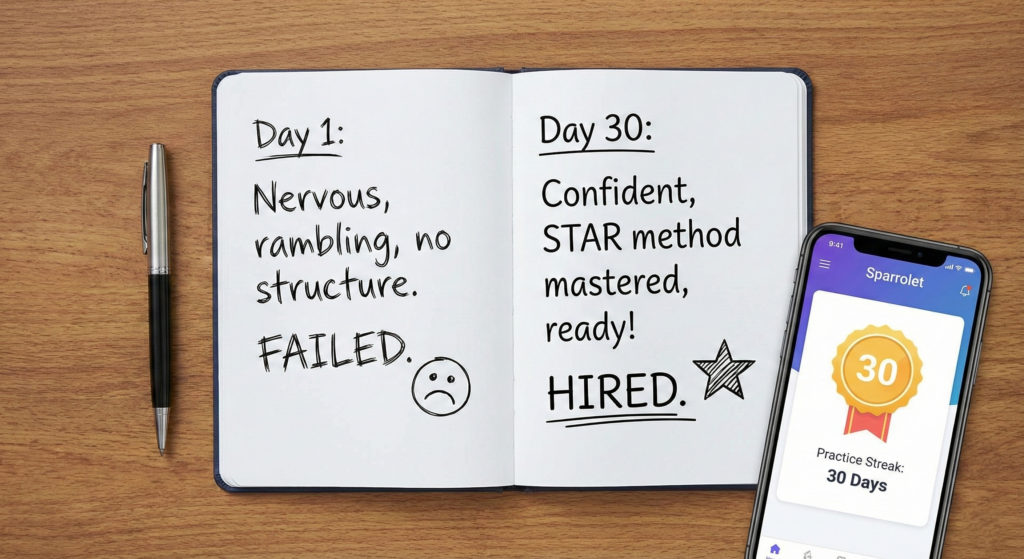
Day 30: Final Review. Compare your Day 30 recording to your Day 1 recording. The difference will shock you.
The Result: You are now “Interview Fit.” You are ready to walk into any room (physical or virtual) and own it.
Summary of the 30-Day Plan
| Week | Phase Name | Focus Area | Outcome |
| 1 | Un-Freezing | Voice comfort, Basic Intro | Reduced anxiety, no freezing |
| 2 | Structure | STAR Method, Career Stories | Clear, concise answers |
| 3 | Curveballs | Difficult questions, “Weaknesses” | Resilience under pressure |
| 4 | Polishing | Body language, Full Mocks | Professional executive presence |
Why Use an App Like Sparrolet?
You might be asking, “Can’t I just practice in front of a mirror?”
You can, but it’s not as effective. Here is why using a dedicated interview preparation app accelerates your growth:
-
Objective Feedback: A mirror can’t record you. It can’t let you play back your answer to hear your tone.
-
Randomization: You can’t surprise yourself. An app can throw a question at you that you weren’t thinking about, simulating the real stress of an interview.
-
Consistency: An app tracks your streak. It gamifies the process. It reminds you to practice. It turns a chore into a habit.
-
Safe Environment: You can fail privately. You can have a terrible practice session at 11 PM in your pajamas, delete the recording, and nobody has to know.
A Real-Life Scenario: The Transformation
Let’s look at a typical user, “Priya.”
Day 1: Priya is a talented developer but terrified of HR rounds. On Day 1, she tries to record her introduction. She stops halfway through, frustrated, because she feels she sounds “stupid.”
Day 15: Priya has been using Sparrolet for two weeks. She has stopped trying to memorize scripts. Instead, she has three solid stories about how she fixed bugs in her last project. She speaks naturally.
Day 30: Priya gets an interview call for a Senior Developer role. Usually, she would panic. This time, she feels a strange sensation: Excitement. She has answered these questions 100 times in the app. She walks in, smiles, and nails the behavioral round.
This isn’t magic. It is simply the result of 30 days of consistent effort.
Frequently Asked Questions (FAQ)
1. Do I really need to practice every single day?
Ideally, yes. Even 5 minutes is better than zero. The goal is to keep the neural pathways active. If you skip a day, don’t quit—just get back to it the next day.
2. Can I use this plan if my interview is in 3 days?
If you don’t have 30 days, compress the schedule. Do Week 1 and Week 2 in a single day (an intense “bootcamp” session). While spaced repetition is better, intensive practice is still better than no practice.
3. What is the biggest mistake people make during practice?
Restarting too often. If you stumble on a word, don’t stop the recording! In a real interview, you can’t hit “restart.” Practice recovering from mistakes and moving on.
4. Is Sparrolet free to use?
Sparrolet offers free practice modules to get you started on your journey.
Final Thoughts: Confidence is Built, Not Born
There is a misconception that some people are just “natural born interviewers.”
That is rarely true. The people who look effortless in interviews are usually the ones who have practiced the most. They have rehearsed their stories in the shower, in the car, and in front of apps until it looks natural.
You have the skills to do the job. Don’t let a lack of interview practice stop you from getting the career you deserve.
Start your 30-day challenge today. Download Sparrolet, press record, and meet the confident version of yourself.